Most commented posts
- PRONUNCIATION – the ED sound — 4 comments
- GRAMMAR – The Passive Voice — 3 comments
- Adjectives + Prepositions (OF) — 2 comments
- Mastering the Modal: Understanding the Versatility of “Would” — 2 comments
- TOO vs. ENOUGH — 1 comment


Dec 12
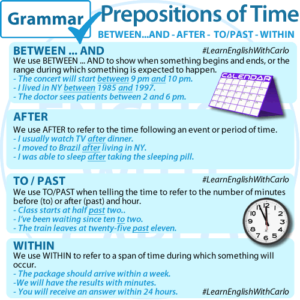
BETWEEN…AND – AFTER – TO/PAST – WITHIN We use BETWEEN … AND to show when something begins and ends, or the range during which something is expected to happen.– The concert will start between 9 pm and 10 pm.– I lived in NY between 1985 and 1997.– The doctor sees patients between 2 and 6 …
Permanent link to this article: https://englishyourway.com.br/grammar-prepositions-of-time-2/
Dec 12
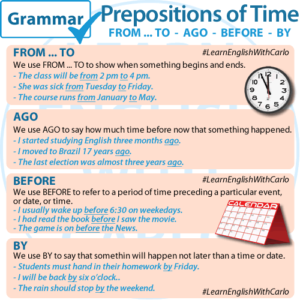
FROM … TO – AGO – BEFORE – BY We use FROM … TO to show when something begins and ends.– The class will be from 2 pm to 4 pm.– She was sick from Tuesday to Friday.– The course runs from January to May. We use AGO to say how much time before now …
Permanent link to this article: https://englishyourway.com.br/grammar-prepositions-of-time/
Dec 04
WHILE and DURING WHILE is a CONJUNCTION that is used to refer to a background period of time in which another activity happened. It is very similar to during, but it is followed by a sentence (while + subject + verb…), so they are not interchangeable. DURING is a PREPOSITION that is used before an …
Permanent link to this article: https://englishyourway.com.br/grammar-confusing-words/
Nov 28
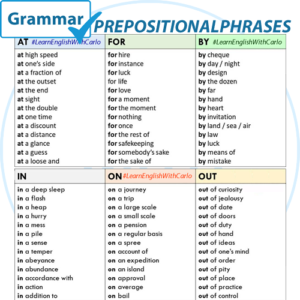
Here are some common prepositional phrases, also known as Collocations with prepositions.
Permanent link to this article: https://englishyourway.com.br/grammar-prepositional-phrases/
Nov 28
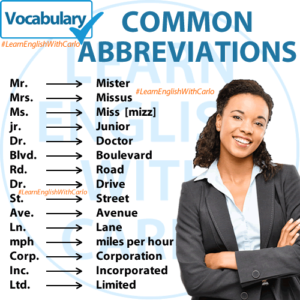
An abbreviation is a shortened form of a word or phrase. Here are some of the more common ones: Mr. – MisterMrs. – MissusMs. – Miss [mizz]jr. – JuniorDr. – DoctorBlvd. – BoulevardRd. – RoadDr. – DriveSt. – StreetAve. – AvenueLn. – Lanemph – miles per hourCorp. – CorporationInc. – IncorporatedLtd. – Limited
Permanent link to this article: https://englishyourway.com.br/vocabulary-common-abbreviations/
Nov 28
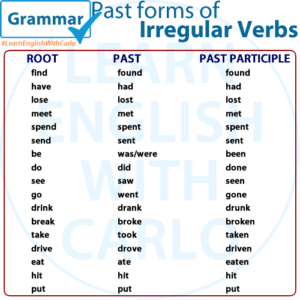
The difference between a regular and an irregular verb is the formation of the simple past and past participle. Regular verbs are consistent—the simple past ends in ed as does the past participle. BUT, the simple past and past participle of irregular verbs can end in a variety of ways, with no consistent pattern. Here …
Permanent link to this article: https://englishyourway.com.br/past-forms-of-irregular-verbs/
Nov 09
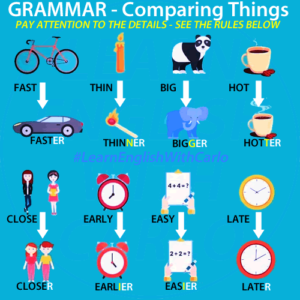
To compare two things, we use what is called a COMPARATIVE ADJECTIVE to what is different between the two things. We do this by modifying the adjective of the characteristic that is different. Here are the rules for this:For adjectives of one syllable:You add ‘ER’Examples:smart – smartERyoung – youngERfast – fastER For adjectives of one …
Permanent link to this article: https://englishyourway.com.br/grammar-comparing-things/
Nov 03
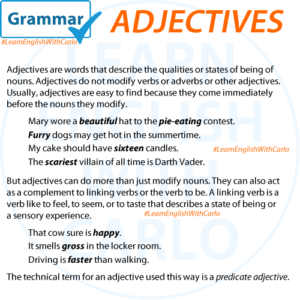
Adjectives are words that describe the quality or state of being of nouns. Adjectives do not modify verbs, adverbs, or other adjectives. Usually, adjectives are easy to find because they come immediately before the nouns they modify. Adjectives can do more than just modify nouns. They can also act as a complement to linking verbs …
Permanent link to this article: https://englishyourway.com.br/adjectives/
Nov 01
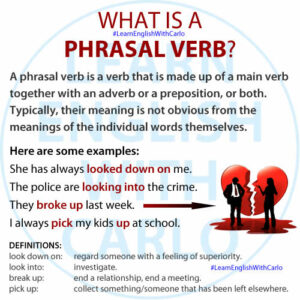
A phrasal verb is a verb that is made up of a main verb together with an adverb or a preposition, or both. Typically, their meaning is not obvious from the meanings of the individual words themselves.There are many phrasal verbs in English. Here are some examples: She has always LOOKED DOWN ON me.(She thought …
Permanent link to this article: https://englishyourway.com.br/what-is-a-phrasal-verb/
Oct 31
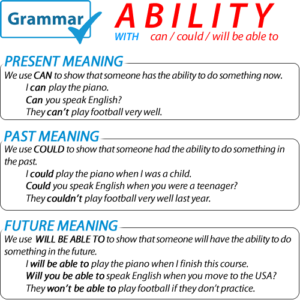
We use CAN to show that someone has the ability to do something now.I can play the piano.Can you speak English?They can’t play football very well. We use COULD to show that someone had the ability to do something in the past.I could play the piano when I was a child.Could you speak English when …
Permanent link to this article: https://englishyourway.com.br/grammar-ability-using-can-could-will-be-able-to/