Verb Tenses
Verb Tense Rules – Explanations
In grammar, verb tenses indicate when something happens, in the past, present, or future. These three main forms can be divided further to add more detail about when. For example, the continuous tenses talk about actions that have continuity – that take place over time. The simple present tense concerns actions that happen every day or describe a state, and the simple past tense refers to something that happened in the past.
Permanent link to this article: https://englishyourway.com.br/esl-grammar-guide/parts-of-speech/verbs/verb-tenses/
Learn How to Talk About Actions Happening Now The Present Continuous (also called the Present Progressive) is one of the most useful verb tenses in English. We use it to describe actions that are happening right now, temporary situations, and planned future arrangements. If you’ve ever wanted to say: then you’re already using the Present …
Forming the positive is relatively easy. All you need to do is add an ‘s‘ to the verb when the subject is ‘he,’ ‘she,’ or ‘it.’ To make the negative form, you need to use ‘do not‘ (don’t) or ‘does not‘ (doesn’t). And we use ‘do‘ or ‘does‘ before the subject to make the ‘yes / …
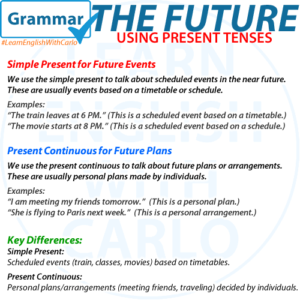
English has several ways to express the future, and each method is used in different situations. Here are the most common ways to talk about future actions, events, or situations. 1. Future with “Will” When to Use “Will” Grammar Rule: 2. Future with “Going to” When to Use “Going to” Grammar Rule: 3. Future with …