WHILE is a CONJUNCTION that is used to refer to a background period of time in which another activity happened. It is very similar to during, but it is followed by a sentence (while + subject + verb…), so they are not interchangeable.
DURING is a PREPOSITION that is used before an activity to indicate that a parallel action is happening at the same time as that activity. DURING is followed by a noun, which often represents an activity (during + noun)
Examples: I will finish reading the book while I’m on my summer break. (while + subject + verb…) I usually take notes while I’m in class. Did you fall asleep while you were watching the movie?
To use during in the above sentences, we have to change the structure of the sentence.
Examples: I will finish reading the book during my summer break.(during + noun) I usually take notes during class. Did you fall asleep during the movie?
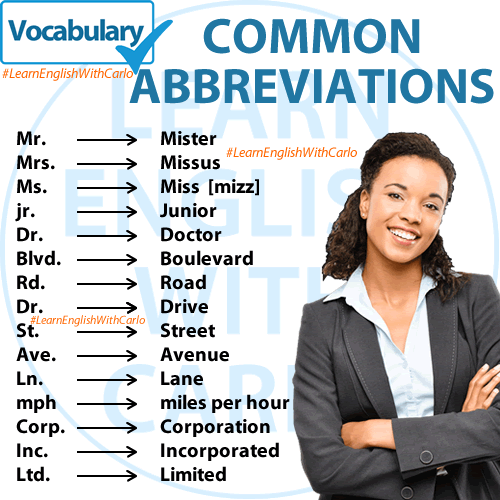
An abbreviation is a shortened form of a word or phrase.
Here are some of the more common ones:
Mr. – Mister Mrs. – Missus Ms. – Miss [mizz] jr. – Junior Dr. – Doctor Blvd. – Boulevard Rd. – Road Dr. – Drive St. – Street Ave. – Avenue Ln. – Lane mph – miles per hour Corp. – Corporation Inc. – Incorporated Ltd. – Limited
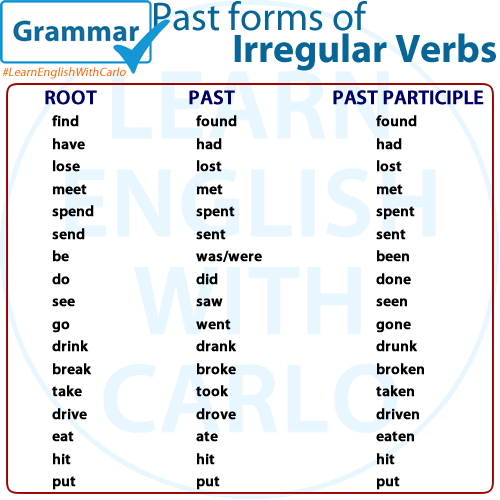
The difference between a regular and an irregular verb is the formation of the simple past and past participle. Regular verbs are consistent—the simple past ends in ed as does the past participle.
BUT, the simple past and past participle of irregular verbs can end in a variety of ways, with no consistent pattern.
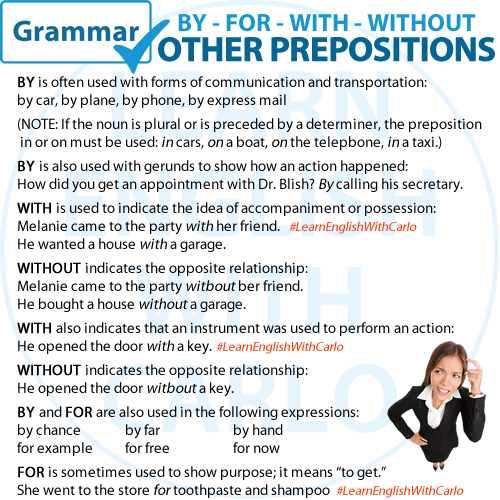
By is often used with forms of communication and transportation: by car, by plane, by phone, by express mail (‘Note: If the noun is plural or is preceded by a determiner, the preposition in or on must be used: in cars, on a boat, on tbe telepbone, in a taxi.) By is also used with gerunds to show how an action happened: How did you get an appointment with Dr. Blish? By calling his secretary.
With is used to indicate the idea of accompaniment or possession: Melanie came to the party with her friend. He wanted a house with a garage.
Without indicates the opposite relationship: Melanie came to the party without her friend. He bought a house without a garage.
With also indicates that an instrument was used to perform an action: He opened the door with a key. Without indicates the opposite relationship: He opened the door without a key. By and for are also used in the following expressions: by chance; by far; by hand. for example; for free; for now
for is sometimes used to show purpose; it means “to get.” She went to the store for toothpaste and shampoo
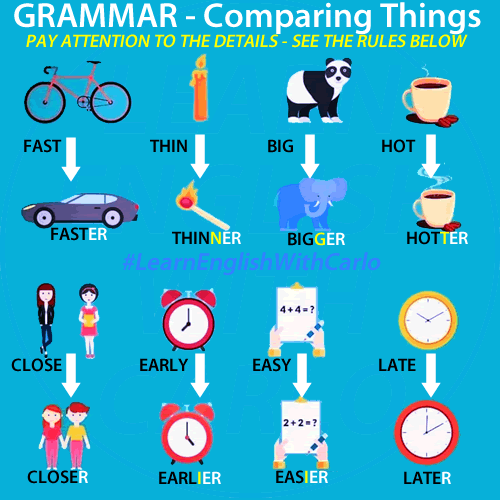
To compare two things, we use what is called a COMPARATIVE ADJECTIVE to what is different between the two things. We do this by modifying the adjective of the characteristic that is different. Here are the rules for this: For adjectives of one syllable: You add ‘ER’ Examples: smart – smartER young – youngER fast – fastER
For adjectives of one syllable that end with Consonant-Vowel-Consonant (C-V-C): You double the last consonant and add ‘ER’ Examples: wet = wetter big = bigger sad = sadder
For adjectives of two syllables that end with a Y You remove the Y and add ‘IER’ Examples: pretty – prettIER happy – happIER lucky – luckIER
For adjectives with two or more syllables (not ending in Y) You add MORE before the adjective. Examples: famous – MORE famous interesting – MORE interesting careful – MORE careful
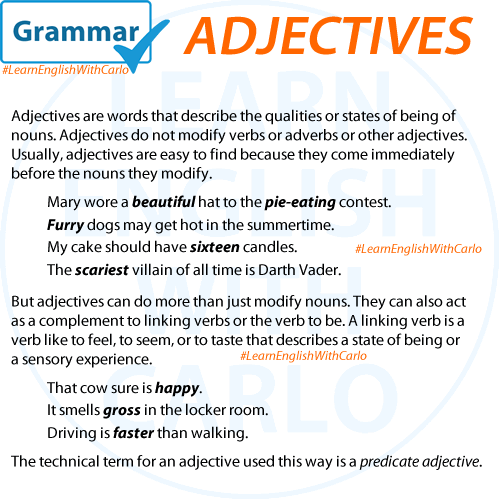
Adjectives are words that describe the quality or state of being of nouns. Adjectives do not modify verbs, adverbs, or other adjectives. Usually, adjectives are easy to find because they come immediately before the nouns they modify.
Adjectives can do more than just modify nouns. They can also act as a complement to linking verbs or the verb to be. A linking verb is a verb like feel, seem, or taste that describes a state of being or a sensory experience.
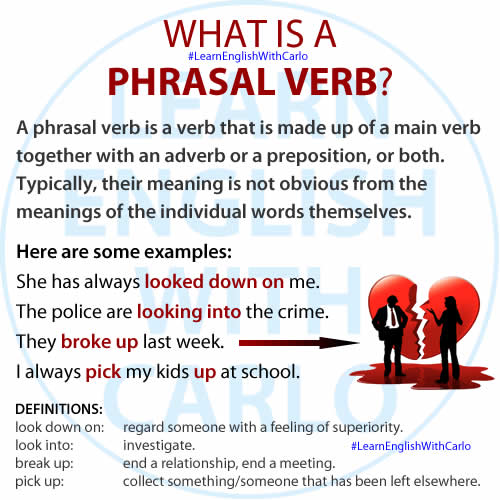
A phrasal verb is a verb that is made up of a main verb together with an adverb or a preposition, or both. Typically, their meaning is not obvious from the meanings of the individual words themselves. There are many phrasal verbs in English. Here are some examples:
She has always LOOKED DOWN ON me. (She thought of me with a feeling of superiority)
The police are LOOKING INTO the crime. (The police are investigating the crime)
They BROKE UP last week. (They ended their relationship last week)
I always PICK my kids UP at school. (I always collect my kids from their school)
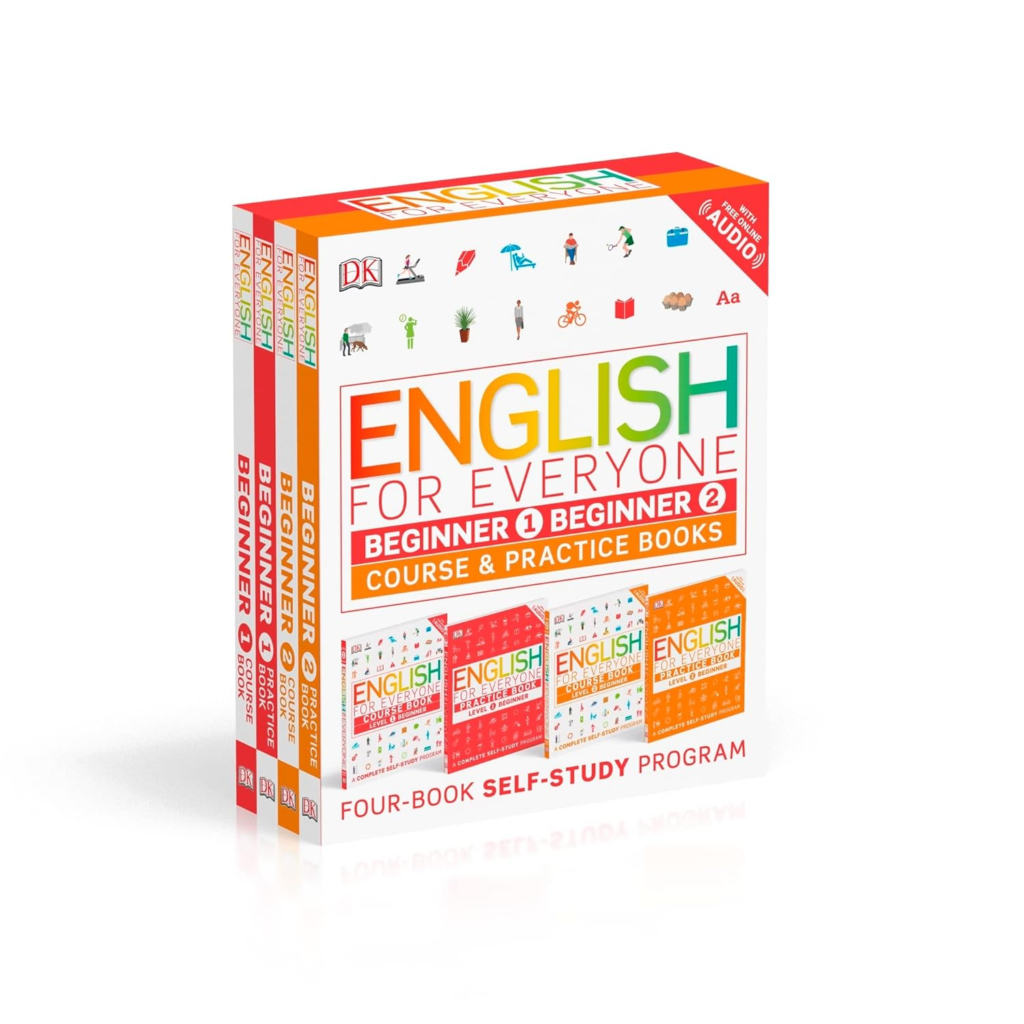
If you’d like to learn more about Phrasal Verbs, click on the link below to purchase a Self-Study Program.
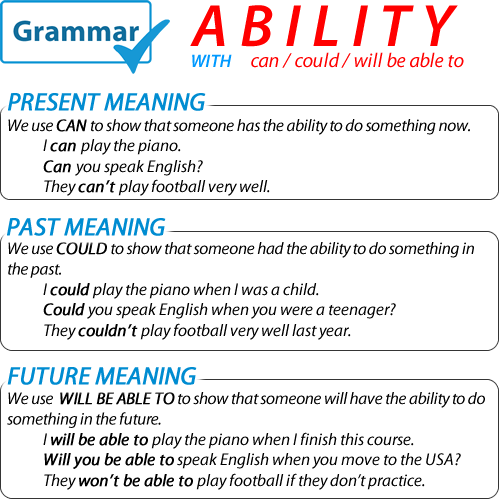
We use CAN to show that someone has the ability to do something now. I can play the piano. Can you speak English? They can’t play football very well.
We use COULD to show that someone had the ability to do something in the past. I could play the piano when I was a child. Could you speak English when you were a teenager? They couldn’t play football very well last year.
We use WILL BE ABLE TO to show that someone will have the ability to do something in the future. I will be able to play the piano when I finish this course. Will you be able to speak English when you move to the USA? They won’t be able to play football if they don’t practice.
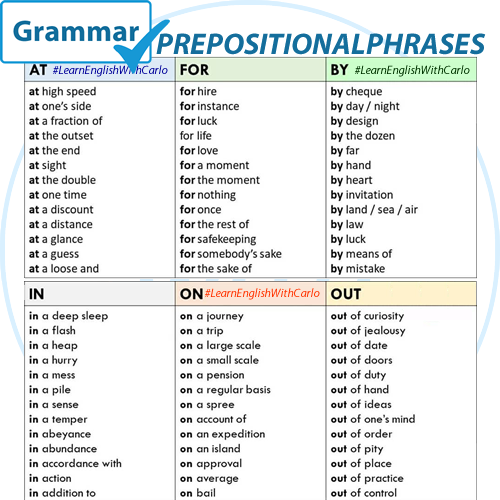
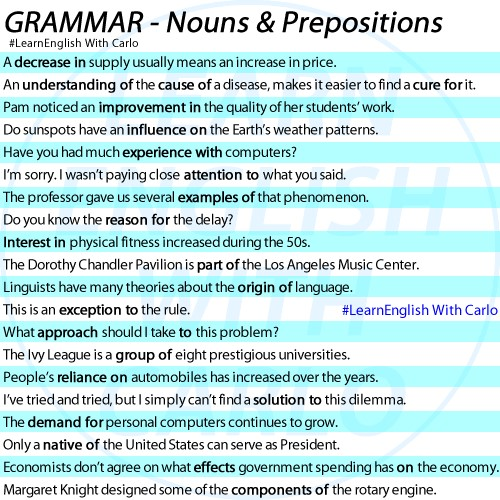
Some nouns are followed by specific prepositions. For example the noun relationship is always followed by with.
A decrease in supply usually means anincrease in price. Understanding the cause of a disease, makes it easier to find a cure for it. Pam noticed an improvement in the quality of her students’ work. Do sunspots have an influence on the Earth’s weather patterns. Have you had much experience with computers? I’m sorry. I wasn’t paying close attention to what you said. The professor gave us several examples of that phenomenon. Do you know the reason for the delay? Interest in physical fitness increased in the 50s. The Dorothy Chandler Pavilion is part of the Los Angeles Music Center. Linguists have many theories about the origin of language. This is an exception to the rule. What approach should I take to this problem? The Ivy League is a group of eight prestigious universities. People’s reliance on automobiles has increased over the years. I’ve tried and tried, but I simply can’t find a solution to this dilemma. The demand for personal computers continues to grow. Only a native of the United States can serve as President. Economists don’t agree on what effects government spending has on the economy. Margaret Knight designed some of the components of the rotary engine.
To provide the best experiences, we use technologies like cookies to store and/or access device information. Consenting to these technologies will allow us to process data such as browsing behavior or unique IDs on this site. Not consenting or withdrawing consent, may adversely affect certain features and functions.
Functional
Always active
The technical storage or access is strictly necessary for the legitimate purpose of enabling the use of a specific service explicitly requested by the subscriber or user, or for the sole purpose of carrying out the transmission of a communication over an electronic communications network.
Preferences
The technical storage or access is necessary for the legitimate purpose of storing preferences that are not requested by the subscriber or user.
Statistics
The technical storage or access that is used exclusively for statistical purposes.The technical storage or access that is used exclusively for anonymous statistical purposes. Without a subpoena, voluntary compliance on the part of your Internet Service Provider, or additional records from a third party, information stored or retrieved for this purpose alone cannot usually be used to identify you.
Marketing
The technical storage or access is required to create user profiles to send advertising, or to track the user on a website or across several websites for similar marketing purposes.