Most commented posts
- PRONUNCIATION – the ED sound — 4 comments
- GRAMMAR – The Passive Voice — 3 comments
- Adjectives + Prepositions (OF) — 2 comments
- Mastering the Modal: Understanding the Versatility of “Would” — 2 comments
- TOO vs. ENOUGH — 1 comment


Jan 23

Here are some very common expressions with their translations to Portuguese. Here are the definitions in English: No way! – Under no circumstances; not at all. My bad. – To take responsibility for a mistake. You bet. – Of course; certainly. What a shame. – When you wish a situation was different, and you feel sad or …
Permanent link to this article: https://englishyourway.com.br/common-expressions/
Jan 22
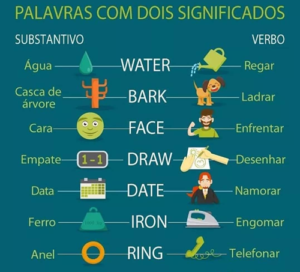
In English words can someties have two meanings. Look at these examples: Water – can be a verb meaning to give water to plants Water – can be a noun (H2O) Bark – can be a noun – the outside part of a tree trunk Bark – can be a verb – what a dog …
Permanent link to this article: https://englishyourway.com.br/words-with-two-meanings/
Jan 22
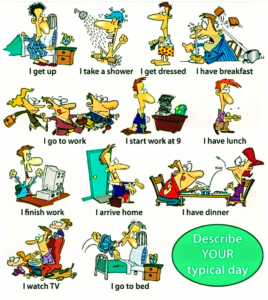
When we talk about things that we do every day, we use the simple present tense. I get up. I take a shower. I get dressed. I have breakfast. I go to work. I start work at 9 am. I have lunch. I finish work. I arrive home. I have dinner. I watch TV. I …
Permanent link to this article: https://englishyourway.com.br/what-do-you-do-every-day/
Jan 09
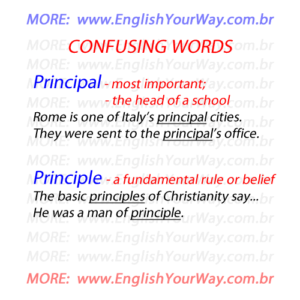
These two words sound exactly the same when spoken. You will only be able to tell the difference by the context. If you have any questions or doubts, please ask in the comments or send me a private message. Follow me on Instagram: @englishyourwaybr or look for the hashtag #LearnEnglishWithCarlo
Permanent link to this article: https://englishyourway.com.br/confusing-words-vs/
Jan 09
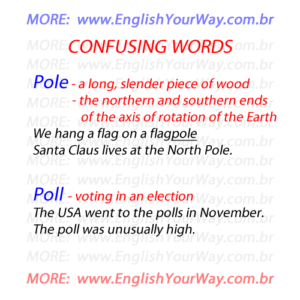
If you have any questions or doubts, please ask in the comments or send me a private message. Follow me on Instagram: @englishyourwaybr or look for the hashtag #LearnEnglishWithCarlo
Permanent link to this article: https://englishyourway.com.br/confusing-words-pole-vs-poll/
Jan 09
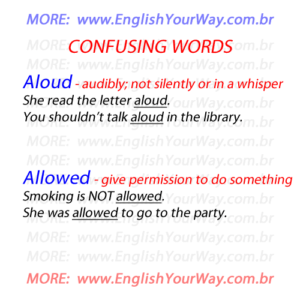
If you have any questions or doubts, please ask in the comments or send me a private message. Follow me on Instagram: @englishyourwaybr or look for the hashtag #LearnEnglishWithCarlo
Permanent link to this article: https://englishyourway.com.br/confusing-words-aloud-vs-allowed/
Jan 09
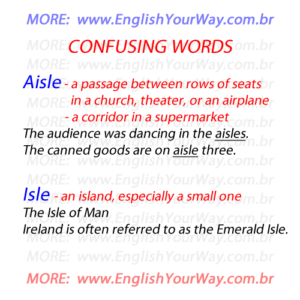
“Isle” and “aisle” are homophones, meaning they sound the same but have different meanings and spellings. Here’s a detailed explanation of each: Isle Definition: A small island or peninsula. Part of Speech: Noun Examples: “They spent their vacation on a tropical isle.” “The British Isles consist of Great Britain, Ireland, and over 6,000 smaller isles.” …
Permanent link to this article: https://englishyourway.com.br/isle-vs-aisle/