Eating meat has long been considered part of a healthy diet, but that’s changing. More and more people are turning away from animal products and finding their nutrients, especially protein, elsewhere.
But there are still a lot of meat eaters who thoroughly enjoy meat. Here is something to help tell the difference between different kinds of popular meat.
Here are the meats in the slide above:
Chop
Ham
Leg
Sirloin
Prime Rib
T-bone
Meatloaf
Pork belly
Sausages
Diced beef
Bacon
Roast Chicken
If you have any questions or doubts, please ask in the comments or send me a private message.
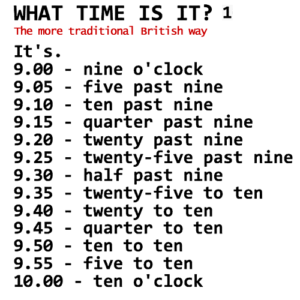
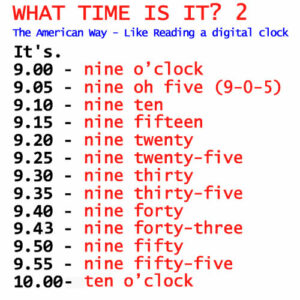
There are two ways to answer the question “What time is it?” in English.
The first is the more traditional British way.
Here you begin by saying the minutes (in intervals of five) and you need to use past plus the hour, or to plus the next hour. (9:20 – twenty past nine; 9:45 – quarter to ten)
The second is the American way.
Here you read the time as if you were reading a digital clock – the hours are spoken first then the minutes with nothing in between. (9:20 – nine twenty; 9:45 – nine forty-five)
Which way do you use?
Which way do you think is easier?
If you have a question or something to say, please send me a private message or write in the comments.
Permanent link to this article: https://englishyourway.com.br/grammar-what-time-is-it/
To provide the best experiences, we use technologies like cookies to store and/or access device information. Consenting to these technologies will allow us to process data such as browsing behavior or unique IDs on this site. Not consenting or withdrawing consent, may adversely affect certain features and functions.
Functional
Always active
The technical storage or access is strictly necessary for the legitimate purpose of enabling the use of a specific service explicitly requested by the subscriber or user, or for the sole purpose of carrying out the transmission of a communication over an electronic communications network.
Preferences
The technical storage or access is necessary for the legitimate purpose of storing preferences that are not requested by the subscriber or user.
Statistics
The technical storage or access that is used exclusively for statistical purposes.The technical storage or access that is used exclusively for anonymous statistical purposes. Without a subpoena, voluntary compliance on the part of your Internet Service Provider, or additional records from a third party, information stored or retrieved for this purpose alone cannot usually be used to identify you.
Marketing
The technical storage or access is required to create user profiles to send advertising, or to track the user on a website or across several websites for similar marketing purposes.